
Tassel

It rained. And when I say rained, I mean poured. Drenching rain. For three and a half hours. Despite the clear plastic ponchos the college provided us, we were wet most of the way through. My fingers literally pruned.
But my daughter flipped her tassel from right to left, walked across the stage, and received her degree. One hundred percent worth it.
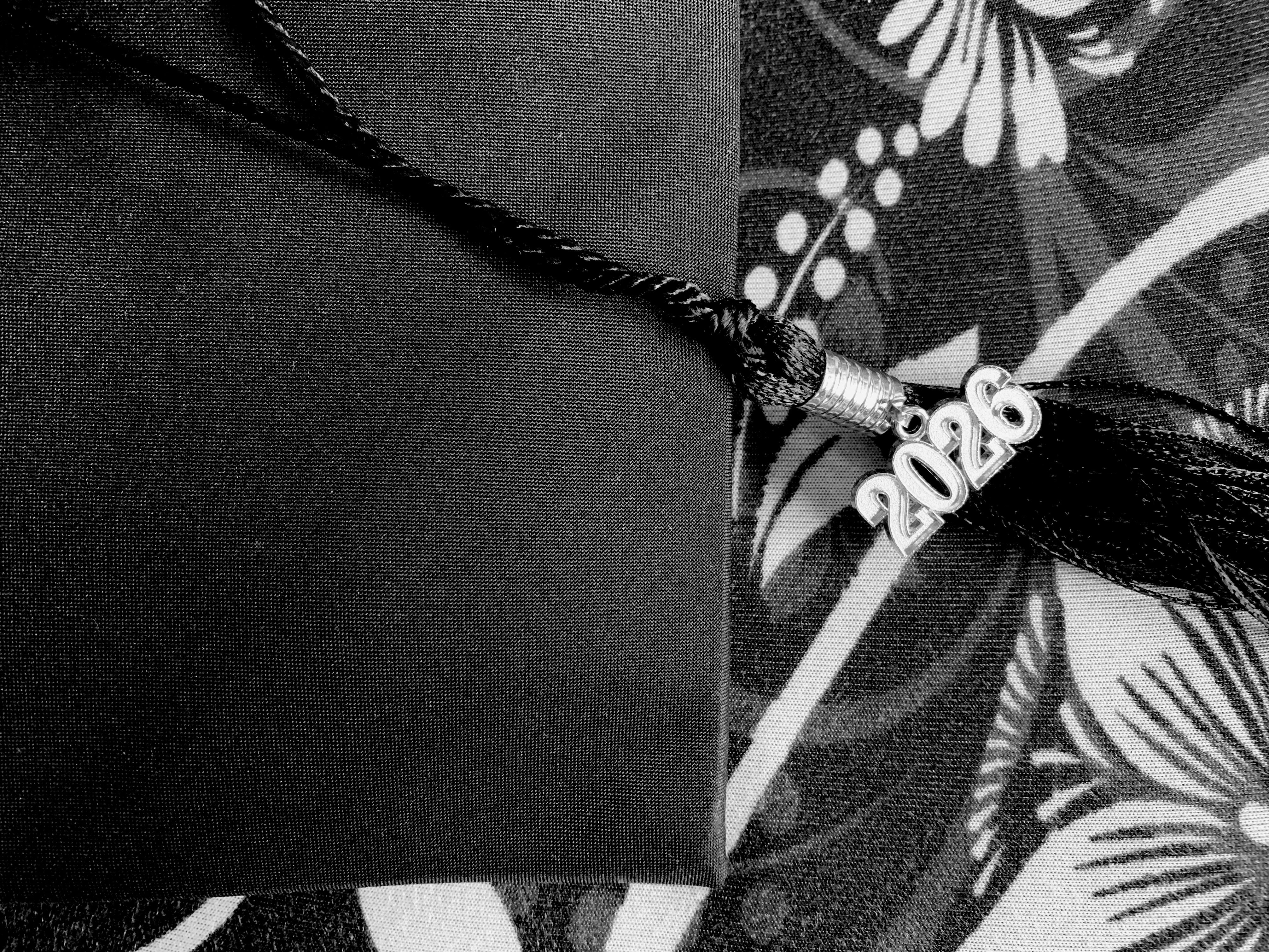
The tassel’s movement marks a moment of transition, an ending and a beginning. It’s rare to encounter such moments made so legible, a single action that launches someone into a new phase, even if that next phase remains uncertain. As in all such moments, despite the ritual meant to crystalize its meaning, hope is accompanied by dislocation and disorientation. The moment asks: what was it all for?
Our culture tends to point to the credential that will translate into a well-paying job and “success.” When I was a college professor, many of my own students were motivated by that piece of paper to the exclusion, unfortunately, of learning. That’s how they justified using generative AI to write their essays or (weirdly) their poems (why take a creative writing elective class if you don’t actually like writing?). It’s why they cheated on tests or stole other students’ homework answers. It’s why they almost never did the reading. Not all of them, of course. But many, maybe even the majority.
There’s a lot of context, of course, to the problem; in “My Students Can’t Read,” Tyler Jagt cites neurological studies indicating that the presence of a cellphone—even one turned off and out of direct sight—reduces working memory. The process of reading on a cellphone is neuologically qualitatively different from reading a hard copy, leading to more fractured understanding of the material, and that is in large part how students practice the art of reading today. In other words, it is literally harder for students to do the kinds of cognitive tasks college asks of them than it was for previous generations.
In the eighteenth century at Oxford University, tassels became part of academic regalia worn by students in order to indicate social status. Students from the nobility wore gold tassels (tuffs, which became known as “toffs,” the colloquialism for the upper class) while commoners wore black ones. These days, most graduates wear black tassels, with gold reserved for those with doctorates. And yet, that tassel, and the piece of paper it symbolizes, still indicates socioeconomic status and potential. They are still a key to the door of professional opportunity. So, it’s understandable, if both regrettable and deeply damaging, that shortcuts become the stopgap.
My officemate had a quotation by Henry David Thoreau taped to our office door: “What you get by achieving your goals is not as important as what you become by achieving your goals.” As a nearly life-long academic, I believe that it’s the process of college that matters. It’s the kind of person someone becomes as a result of that process that matters.
I used to believe, unironically, that learning how to think critically would lead, somehow magically, to becoming a good person—very Platonic of me. If you know what doing good is and how to do good, you will do good. I believed that we could think our way to goodness. But there have been many brilliant minds that have been put into the service of destruction, of harm, of, dare I say, evil. Ted Kaczynski. Richard Loeb and Nathan Leopold. Amy Bishop. And these people weren’t just smart; they were educated.
But that doesn’t mean learning to think doesn’t help. I mean, the state of America at the moment is evidence enough of that. One of my goals in my writing courses was to teach students the ways in which language is performative (according to J.L. Austin’s definition in “How to Do Things with Words”)—that is, designed to make something happen, usually by having the recipient do what the speaker/writer wants. Recognition of this fundamental attribute, I hoped, would help students evaluate the language coming at them and determine whether the implied or explicit message served them, and society, well.
Still, critical thinking, or logic, is not enough on its own. Really, what I hoped my students took away from my classes is awareness. Self-awareness—who am I, what am I doing, and why? No, for real? Awareness of others—who are others and what are their experiences? How can I help?
And the lynch pin that holds it all together: curiosity.
I still think college educations and their resulting credentials are useful despite their flaws. The one my daughter got at Vassar College certainly is even if it won’t necessarily lead to a high salary or powerful position out of the gate (especially in this economy). She came into close contact with new ideas and people from all kinds of backgrounds. She did things she had never had the chance to do before, both socially and academically. She grew in her humanity.
College isn’t the only way to achieve these results, but it is one way. It’s a perennial argument that we need to rethink and re-engineer education, and, we really, really do need to do that, especially now.
The tassel needs to matter.
References:
J.L. Austin, “How to Do Things with Words,” The William James Lectures Delivered at Harvard University in 1955. https://raggeduniversity.co.uk/wp-content/uploads/2025/03/Austin-J.-L.-How-to-Do-Things-With-Words.pdf
Tyler Jagt, “My Students Can’t Read,” Chronicle of Higher Education. https://www.chronicle.com/article/my-students-cant-read
The Thoreau quote! I’m so pleased. Fantastic essay!
Thank you for this one. Your reflections as a proud, if soaked, mother and your call to improve college education both spoke to me.