
Multiples (Othello)

I have six copies of Shakespeare’s Othello on our house’s library shelves, two from Signet Classics, one from the Folger Shakespeare Library, and three in anthologies (two copies of Necessary Shakespeare and one copy of The Riverside Shakespeare). Some are from when I was a college and grad student many years ago. Some are editions I used when teaching my own college Shakespeare courses.
Othello, for those not familiar with the play, is all about a Moor, a Black man, who marries a White woman. Out of deep envy and overall maliciousness, Othello’s servant Iago incites Othello’s jealousy by making him believe that his wife Desdemona is having an affair with his White lieutenant. Eventually, Othello kills both Desdemona and Iago and then himself.
The materiality of these books reminds me of how long I have lived with them—and how long they have lived with me. The two Signet Classics are from 1986. The covers feature a line drawing by Milton Glaser with Othello, hands around Desdemona’s neck, looking out at us, while a creepy cornice featuring a blank-eyed Cupid also gives us the side-eye. The pages have turned a brownish-yellow, a golden citrine deepening at the edges. The Folger edition from 1993 has also begun the yellowing process; its cover features a rich red splotchy background, looking rather like parchment soaked in blood. All three smell of old paper, the perfume of used bookshops.
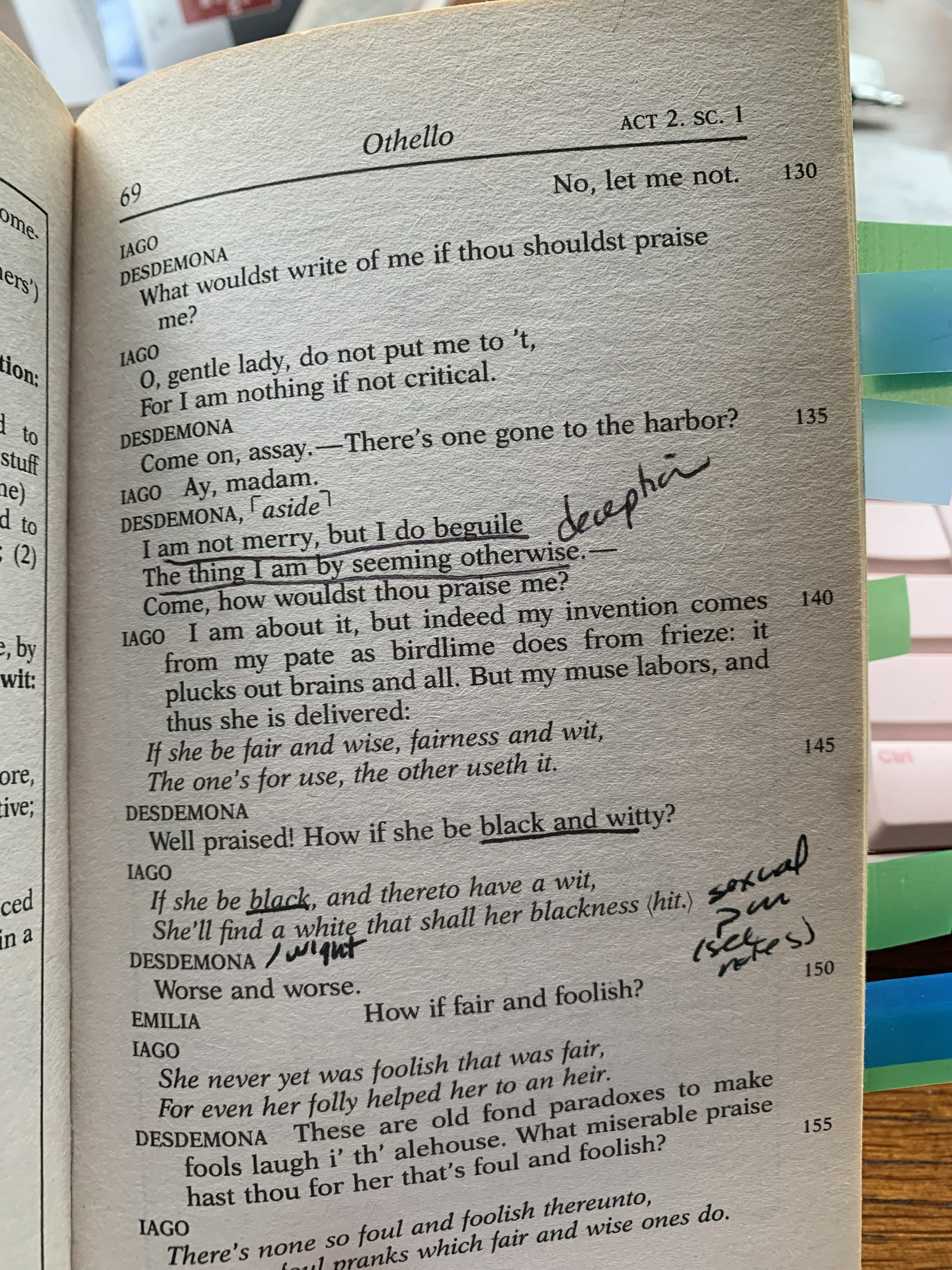
All six of my copies are heavily annotated with underlining and marginalia—sometimes phrases, sometimes stars, sometimes check marks. What is surprising to me, but should not be, is how consistently the same themes and passages caught my attention. I apparently love the joke in the first scene of Act I, when Brabantio (Desdemona’s father) accuses Iago of being a villain, and Iago replies “You are—a senator,” implying the two words are synonymous.
But what really spoke to me back then was the triangulation of epistemology (how we know what we know), deception, and relationships. In five of the six copies, I’ve underlined Desdemona’s words in Act 2, Scene 1: “but I do beguile / The thing I am by seeming otherwise.” Here, she is pretending to be happy even though she is worried that her husband might have been lost at sea in a storm. And wow, as a woman in today’s world, do I get that. How am I? I’m fine. I am absolutely fine. I am okay. Even when I am patently not fine. Even when the world is a dumpster fire. But it’s an imposition to say otherwise, and I’ve internalized the message that my job as a woman is to make others feel comfortable. And there’s always the fact that I could be accused of being over-emotional, of being dramatic, because after all, I am a woman.
Desdemona lies again, this time with her words, when Othello asks her where the handkerchief that he had given her is. She knows it is missing, but she can’t remember what happened to it. What we know from earlier dialogue: Desdemona had offered to use it to try to soothe Othello’s headache, but he tells her it is too small. What is up to the discretion of the book editors or the director of a performance is the stage directions that come next. Some say that the handkerchief drops, unnoticed. Some say Othello pushes it away, causing Desdemona to drop it. Or maybe he even grabs it from her and throws it to the ground. His next line is “Let it alone.” Does the “it” refer to his headache? Or does he instruct Desdemona, who is stooping to pick up the discarded square of fabric, to leave it where it lies? Is it actually his fault that it is lost? It matters because Othello blames Desdemona for its loss, thinks she has given it to her lover. She doesn’t help matters by saying of course she knows exactly where it is when she doesn’t. She lies. And that dooms her.
Desdemona rationalizes why Othello seems angry with her: it must be matters of state that have him so tense. In other words, she lies to herself, even after he has hit her. When he reveals to her his misguided belief that she has had an affair and his intention to kill her, at first she doesn’t believe him, and then she, until the last moment, thinks she can talk her way out of it by pleading for one more day, one half hour, the space of one prayer. Her very last act before death is another lie: when asked who has strangled her, she says “Nobody. I myself.”
Desdemona utters these words to protect Othello, but also to acknowledge her own—though only partial—responsibility. And yet, it makes absolute sense that she lies throughout the play. Without deceiving her father, she never could have married Othello in the first place. But that deception is what initially convinces Othello she is untrustworthy. When Othello confronts her about the handkerchief, he threatens her with “perdition / As nothing else should match” if it is either lost or given away. So, of course she lies. She lives in a society in which reputation is everything, is in fact a matter of life or death, especially for women.
But even beyond her own deceptions, Desdemona is at the mercy of someone who simply isn’t very good at interpreting signs, especially because he is fundamentally insecure within the relationship. Othello wonders why Desdemona would choose him considering his age and his race. He absolutely cannot see Iago for who he is and never questions whether the sole source of his information is reliable. Perhaps the most egregious of Othello’s misinterpretations: he cannot even tell whether Desdemona is actually dead. He declares she is “still as the grave.” He briefly wonders if she is stirring but immediately denies the possibility. She, of course, is not dead, not yet.
Othello has a lot to say to us about the ways that deceit—both small and large—infiltrate our lives and our culture. It has a lot to say about what it costs us to go along to get along, but also about what is potentially at stake if we don’t. It has a lot to say about the consequences of not questioning how we know what we think we know and whether the sources of our information are truly reliable. It says a lot about how our insecurities can be used against us to create a willingness to become violent or at least cruel. Honestly, it speaks to our times in ways I wish it didn’t.
You wrote, "and I’ve internalized the message that my job as a woman is to make others feel comfortable."
I think I missed that lesson. :)
I agree about misinformation or lack of credible information or letting insecurities rule us... I think it's also about how completely, and utterly, downright stupid people can be.
Though I'm unsure how Shakespeare would have written that... perhaps:
Methinks it speaks as well to the boundless folly of mankind, how prodigious in its scope and most lamentable in its display.
This is moving and very perceptive. Iago used to be accused of ´motiveless malignity’, which always surprised me because he tells his motivation clearly. He says of Othello « He has a daily beauty in his life/ Which makes me ugly. » Bang. There it is. Btw, we need to remember that a Moor was not a Black man but a Moroccan (probably) who worked for the Venetian Republic. Lovely post!