
Mending

I lay out the necklace on my desk, its gold chain links winking in the light. I open the packet of tiny jump rings I bought at Michael’s Crafts six months ago. First, I try prying open a jump ring with my fingernails. Then I try with tweezers. Finally, I go all the way downstairs to the toolbox to get the pliers. That works. I carefully slip three jump rings onto the ends of chains and crimp them together again. A five-minute job takes forty, but the necklace is fixed.
My mother wore the necklace over brown polyester shirts with green paisleys dotting the fabric, dangled its two-foot length over scratchy turtlenecks and flared pants in the 1970’s. I delight in the paradox its beads reveal that a circle can indeed fit in the square hole. It just needs a little bit of extra space. Four years ago, the chain popped apart as I took the necklace off one day after teaching. Truth is, I yanked it, and it broke. It has been sitting on my writing desk ever since.
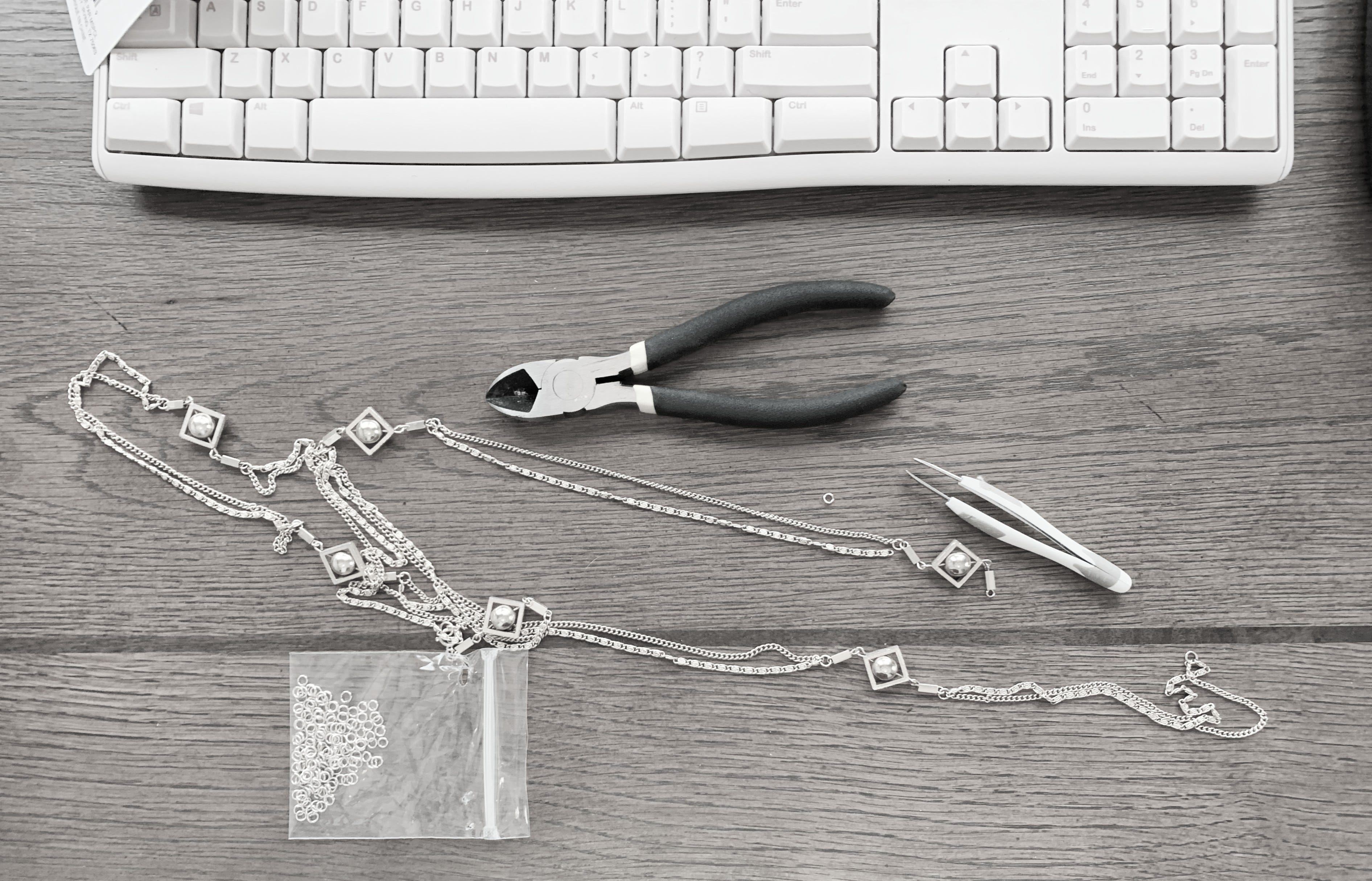
I could have made the repair invisible by replacing the compromised jump rings altogether, but I chose to add extra jump rings to the chains instead. Repair does not bring back my mother, dead by the end of the 70’s from drinking too much. This necklace isn’t now what it was then. And it also is what it was. It contains both my mother’s groovy 1970s vibe, her cigarettes and whiskey, and my own impatience, the sometimes-awkward way I move through the world as I try to contribute to it.
For a long time, I thought that mending meant making perfect. Making it look like nothing had happened.
On my threadwork social media feed, visible mending has been trending. Instead of hiding the repair, it’s featured front and center, the hole woven over with contrasting yarn, the seam whipstitched closed on the outside, not the inside, of the garment. The Japanese have this tradition in the art of Kintsugi, where the rejoining of pottery becomes not just visible, but celebrated, made the entire focus, through lacquer mixed with gold.
It's not a coincidence that I fixed the necklace the same week I finished the final draft of an essay collection. Each essay focuses on an object and how it shows me my place in my family, my communities, and the world. I write a lot about my father and the distance between us created by a genetic secret and cultures of masculinity. I write a lot about my mother, her rebellion, her addiction.
As I worked on the collection, I kept trying to come up with the killer line—you know, that one punchy sentence that encapsulates the work, the one you need to solicit agents and publishers and to reply to well-meaning friends who ask what you’re writing. I knew it had to do with healing, with trusting myself, with belonging, with forgiveness. But I couldn’t write toward that goal. I didn’t know what such a thing would look like. I hadn’t achieved it. It felt, somehow, false, like the stubborn brokenness of my childhood and my family refused to be made whole.
It was only after I finished the collection that I realized: the essays—and the writing of them—are themselves the visible mending. Each essay is a reconfiguring of the past, an understanding, a mending. Through the process of writing, the reckoning, the research, the discovery, the remembering, the framing, the contemplation, the putting of one word after another, I’ve come to some measure of acceptance. It’s likely that the mending I’ve done will fray over time, but now I know repair is at least possible, even if what’s repaired won’t be as strong as what it might have been if never broken. And I know it can be beautiful.
Another lovely piece that spoke to me. Can't wait to read the essays!
I thought about kintsugi as I was reading & was delighted to see you featured it. Beautiful reflections!